Home  /  Training Resources  /  Tattoo Machines

TRAINING RESOURCES · TATTOO MACHINES

Understanding Tattoo Machines

A fine line depends on your hand, but also on how the needle moves. This entry explains the three main machine types, what stroke and voltage change, how to hold a machine for long sessions without strain, and the routine that keeps it running consistently.

01 · MACHINE TYPES

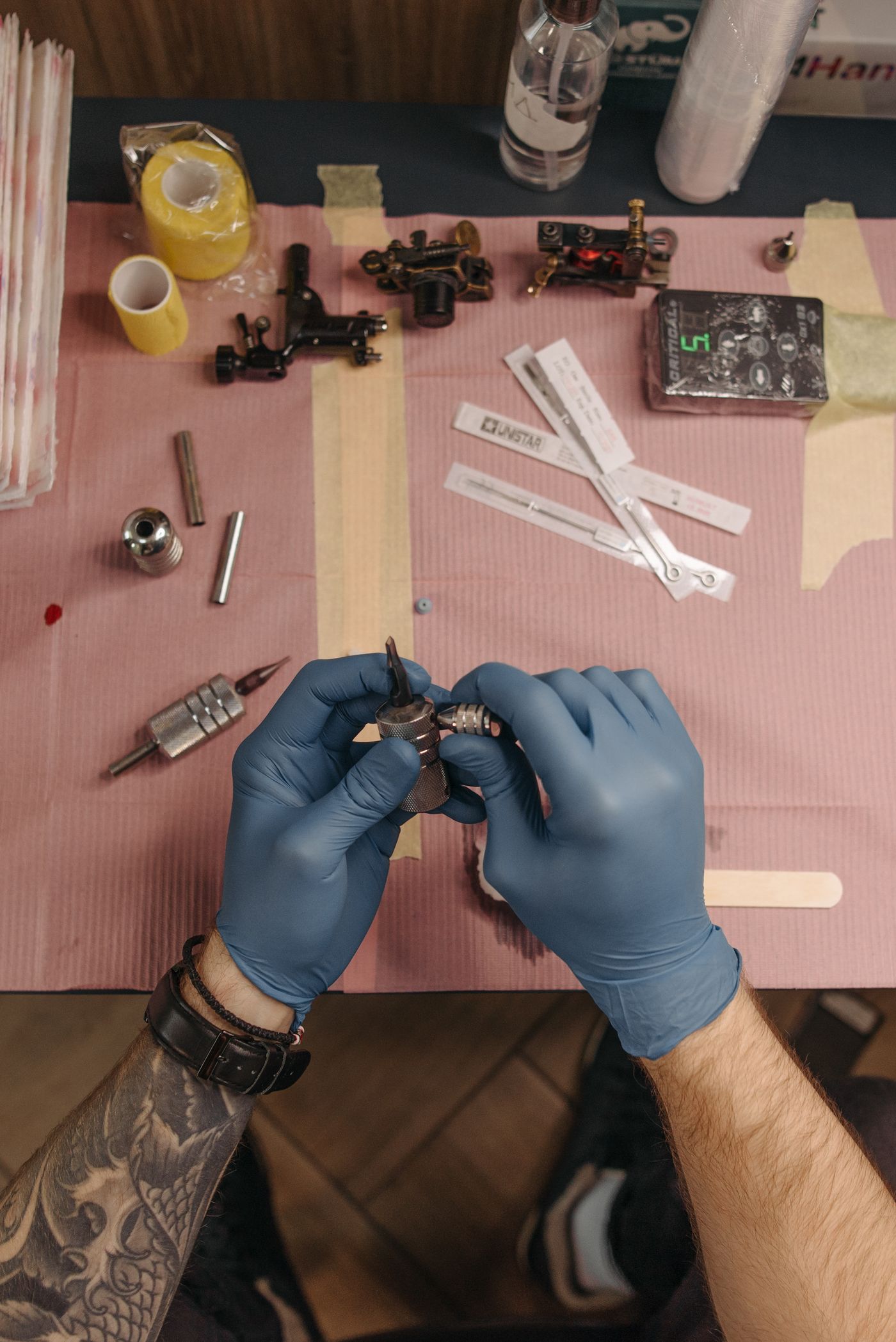
Rotary, pen and coil: how each one moves the needle

All three push a needle in and out of the skin. They differ in the mechanism that drives the needle, and that changes how the machine feels in your hand and how it responds on the skin.

ROTARY

Motor-driven and steady

A small motor turns a cam that moves the needle in a smooth, even cycle. Rotaries run quietly with little vibration, which helps when you need a consistent pass for delicate lines. They work with traditional needle bars or cartridges, depending on the model.

PEN

A rotary shaped like a pen

Pen machines house the rotary mechanism in a slim barrel and take cartridge needles. Because you hold them much like a drawing tool, many fine line artists find them intuitive. Cartridges also make needle changes quicker and cleaner.

COIL

Electromagnetic and tunable

Coils use electromagnets to pull an armature bar up and down, so they buzz and have a lively feel. They can be tuned closely for lining or shading, but they’re heavier and need more adjustment. Learning how a coil works is still useful for understanding how any machine behaves.

02

Stroke and voltage, in plain terms

Stroke: how far the needle travels

Stroke is the distance the needle moves out of the tip with each cycle. A longer stroke hits with more force and puts ink in quickly, but it’s less forgiving. A shorter stroke feels softer and suits gradual build-up. For fine line work, the aim is a stroke that deposits a clean line in one pass without overworking the skin. Some rotaries have a fixed stroke and others can be adjusted.

Voltage: how fast the machine runs

Voltage from the power supply controls how fast the needle cycles. That speed has to match your hand speed. If the machine runs too slowly for your pass, the line breaks up or looks dotted. If it runs too fast, you can overwork the skin and cause blowouts. That relationship between speed, depth and skin tension is covered in more detail in How to Build Clean, Consistent Line Work, and it’s also how needle choice affects the result, explained in A Guide to Tattoo Needles for Fine Line Work.

03 · GRIP AND ERGONOMICS

A machine you can hold steadily all session

Fine line work punishes fatigue. As your wrist tires, your lines start to wobble. Balance and grip matter as much as the motor.

Weight and balance. A lighter machine with its weight near the grip reduces strain on the wrist.

Grip diameter. Choose a grip that lets you hold loosely. A tight grip makes your lines tense.

Cable drag. Route the cord so it doesn’t pull on your hand mid-stroke. Some artists use wireless battery units for this.

Anchoring. Rest the heel of your hand or your little finger so movement comes from a stable base.

04 · MAINTENANCE ROUTINE

Keeping a machine consistent

A machine that behaves differently from one day to the next makes consistent lines impossible. Build a routine and follow it every time.

Barrier first. Cover the machine, grip and cord in barrier film before every session, and replace it between clients.

Wipe down after. Clean all surfaces with a disinfectant suitable for the machine’s materials, following the manufacturer’s guidance.

Listen and check. A change in sound, a sticking cartridge or a loose connection usually shows up before a failure does.

Service as directed. Coils need regular tuning and parts replaced as they wear. Rotaries and pens should be serviced according to the manufacturer’s schedule.

Barrier and cleaning routines are part of wider station hygiene. See Tattoo Hygiene & Safety Basics.

Learn it with the machine in your hand

Reading explains the mechanism. Setting up, tuning and running a machine under guidance is what builds control. Tattoo Machine Training covers setup and handling, and Line Work Training turns that control into clean, repeatable lines.