TRAINING RESOURCES · TATTOO NEEDLES
A Guide to Tattoo Needles for Fine Line Work
The needle decides how much ink enters the skin, how crisp an edge reads and how a line settles as it heals. This guide explains the codes, groupings, taper and gauge behind every cartridge.
01
READING THE LABEL
How to read a needle code
Most cartridge packaging carries a short code such as 1003RLLT. It looks cryptic, but it is simply a written record of four decisions, read left to right. Manufacturers vary slightly in format, so always check the maker’s own chart.
10Gauge: the diameter of each needle point.
03Count: how many needle points are soldered together.
RLGrouping: how those points are arranged, here a round liner.
LTTaper: how gradually each point narrows, here a long taper.
02
Groupings and what each one does
Fine line work leans on the tightest groupings, but understanding all of them explains why.
ROUND LINERS · RL
The fine line workhorse
Points pulled tightly into a circle deliver a single, concentrated line. Single-needle and three-needle liners are the familiar choices for script, botanicals and delicate outlines.
ROUND SHADERS · RS
Looser, softer marks
The same round arrangement, spaced more loosely. It lays softer tone and small fills, and is useful for subtle shading that sits beside fine outlines without overpowering them.
MAGNUMS & FLATS · M1, RM, F
Coverage, not contour
Points set in rows cover wider areas for blending and packing. They appear less in pure fine line pieces, yet knowing them helps you judge when a design has outgrown the style.
03
Taper and gauge
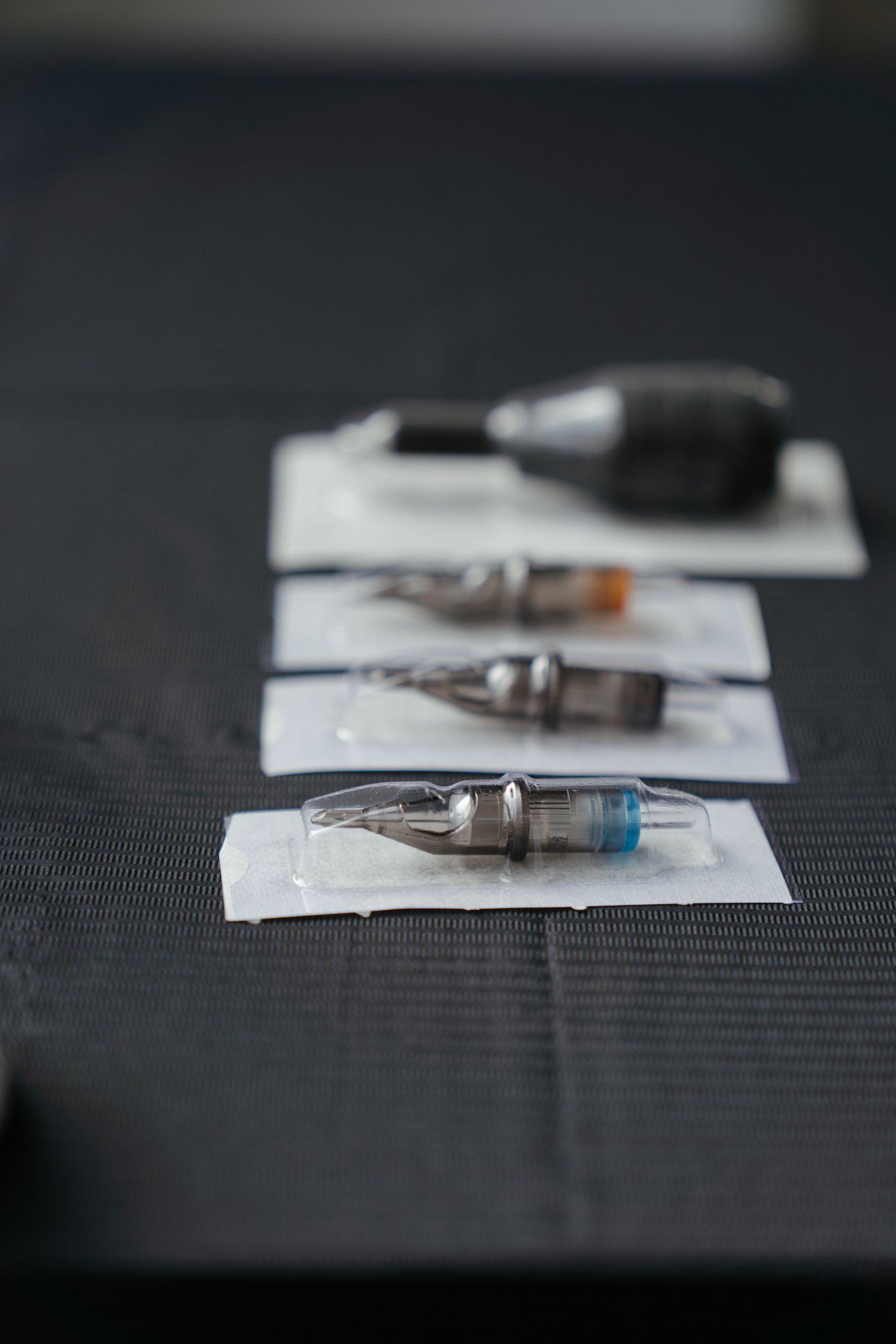
Gauge is the point’s diameter. Common sizes include #08 (about 0.25 mm), #10 (about 0.30 mm) and #12 (about 0.35 mm). A finer gauge releases ink more slowly, which suits controlled, delicate lines but asks for a steadier pass.
Taper describes how gradually the point narrows. A longer taper gives a sharper tip and crisper detail; a shorter taper releases more ink per pass. Taper lengths are defined by each manufacturer, so compare within one brand.
04
FROM CARTRIDGE TO SKIN
How needle choice shapes a fine line result
No needle makes a clean line on its own. The cartridge sets the limits; hand speed, depth, stretch and machine setup decide what happens inside them. Keep these relationships in mind when choosing.
Line weight is planned, not guessed. Match the grouping size to the thickness the design needs once healed, not just on the day.
Spacing protects the design. Very fine lines placed too close together can soften into each other over time, whatever needle drew them.
Speed follows ink flow. Finer gauges and long tapers usually call for a slower, even pass so the line does not skip.
Cartridges are single-use. Sealed packaging, membranes and correct disposal belong to hygiene practice as much as to technique.
TRAIN IT HANDS-ON
Where needle choice is taught
07Needle & Technique Training: choosing cartridges and applying them with control.
03Advanced Fine Line Tattoo Course: refining line weight and detail on existing skills.
RELATED READING